
As a mechanical services company, through the years we have seen a variety of commonly asked questions, some being:
- What are the differences between water and refrigerant systems?
- When should I use each system?
While neither answer is wrong, they both have pros to weigh up your final choice, working more efficiently in different environments.
Key Features:
- Water-Based (4-pipe/2-pipe)
- Refrigerant Based (AC)
- When is it good to use these systems?
Water-Based (4-pipe/2-pipe)
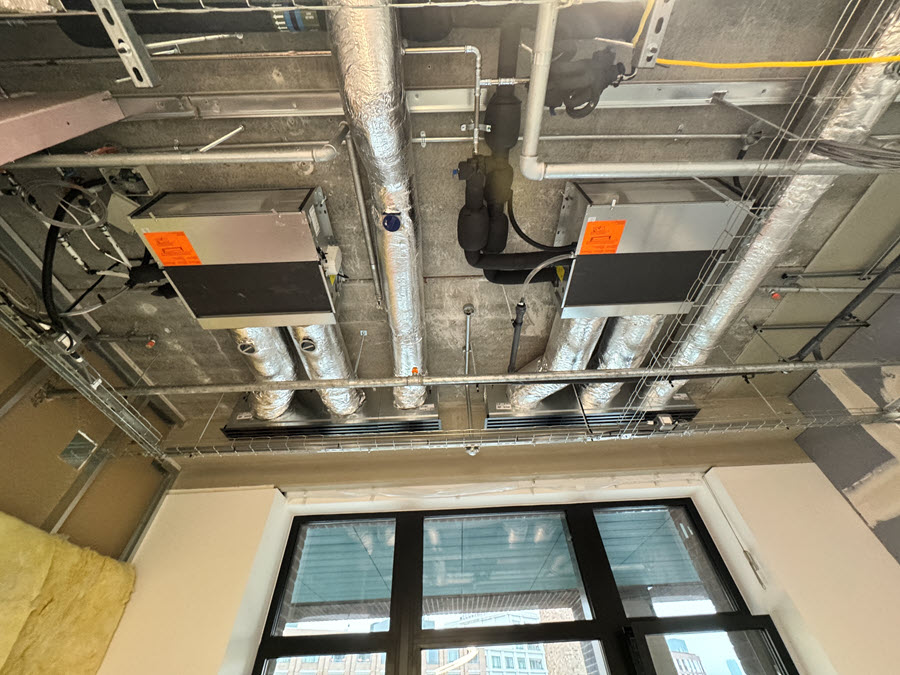
So what is a water-based system? A 4-pipe system uses two circuits. They use separate piping for heating and cooling attached to a chiller and boiler. They produce hot and chilled water efficiently passing it through the building, until the water reaches the FCUs or AHUs. Fan then blow air across heat exchangers containing either hot or cold water. 2-pipe systems work similarly but only using CHW (chilled water).
Starting off strong, water-based systems have significant longevity. If properly maintained, as they will be at Bryair, these systems can qualify for exemption from strict F-Gas regulations. It would eliminate the risk of refrigerant leaks within occupied spaces due to being located in the central plant. Overall this makes our 4 and 2-pipe systems generally safer.
When limited outdoor space prevents installing condensers, water-based systems can provide the ideal solution. The systems chillers and boilers are usually located within the basement space or roof. This means there is no need to worry about where the condensers will be placed externally.
Where work force efficiency is necessary, on the ground level, water-based systems have their advantages. Firstly, proper installation of the fan coil units can ensure quieter operation. Meaning they produce non-intrusive background noise.
They also have the ability to manage humidity levels. Chilled water increases latent heat intake, a type of ‘hidden’ energy, which helps allow comfortable internal conditions. In the long run this will increase the productivity levels of your team. This is a good thing for the way your company runs.
Refrigerant Based (AC)
What is a refrigerant system? We refer to a refrigerant system, which exists as gas or liquid, as air conditioning (AC). This can come in many forms; ducted, wall mounted or cassette. It takes external air and converts it into either hot or cold air when combined with the AC. You will commonly find it in R32 or R410A.
It has many advantages including the boost in sustainable efficiency. In this case, the system moves heat instead of generating it, which reduces energy use by 30% to 50%. This result appears to be the case as it is room specific, meaning it doesn’t affect the rest of the building. It also lies in the fact that it doesn’t affect the rest of the building – it allows for individual control and built in redundancy.
Water-based systems suit installations where there is no room for an outdoor unit, while refrigerant systems suit buildings where a chiller is not feasible. There is more space to work with.
Due to individual control, refrigerant systems provide faster reaction times, where someone may turn on the system, it’s instantaneous reaction time provides quicker heating or cooling to the room.
Ultimately, we see that refrigerant systems cost less than water-based systems because DX systems have a simpler design and require less complex installation.
When is it good to use these systems?
4-pipe/2-pipe:
- Large buildings
- Facilities with continuous or heavy cooling loads
- Applications requiring centralised cooling
- Quiet areas
- Areas with limited outside space
Refrigerant AC:
- Offices, retail spaces and smaller facilities
- Spaces needing precise, localised temperature control
- Limited installation space
Final Remarks
Largely, both water-based on refrigerant systems bring clear advantages but it ultimately comes down to what your building space requires. Water-based systems offer strong, long-term solutions, offering safety, quiet operation and reliability. We can observe this in larger buildings or areas where outdoor space is limited. In contrast, refrigerant systems offer a cheaper and flexible approach, making them ideal for smaller or more adaptable spaces, which can be the deciding factor for many projects.
Ultimately, there is no one-size-fits-all approach. It is mainly choosing the right system for the right environment. You can ensure you select a unit that performs well in the way your building operates
If you have a project you’d like to discuss, please contact us.