
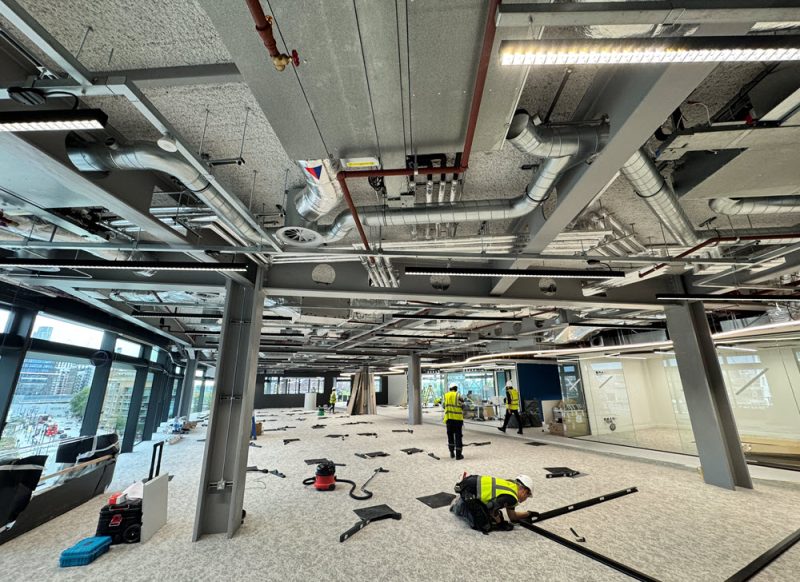
As a company existing in the mechanical services and public health sector, it is essential that we prioritise sustainability.
Our sector’s services remain one of the largest consumers of energy. In fact, in commercial buildings, we contribute to 40% of the total energy consumption. This high usage is mainly due to our HVAC systems – heating, ventilation and air conditioning.
Therefore, our services need to include methods of sustainability, so companies like ours can continue to thrive while remaining viable for the environment.
Key Features:
- MVHR – Heat Recovery
- VRF Systems
- PIR’s
MVHR – Heat Recovery
For various reasons, our company likes to push their clients to using this system for ventilation.
Without a MVHR for heat recovery, warm indoor air will eventually go stale. Most people will open a window to let it out and fresh outdoor air will come in. In this situation without the MVHR, you are losing potential energy. With an MVHR, the system first extracts air from inside while drawing in fresh cold air from the outside, or vice versa. Then, the air passes through the MVHR, ultimately heating or cooling it. In this way, we effectively recycle the energy.
The filtered air that comes from the MVHR not only reduces pollutants, allergens and CO2 build-up, but also helps improve well-being and productivity within your office space and working environment. As a result, it’s a win-win for both us and you!
VRF Systems
Variable Refrigerant Flow (VRF) systems are optimal for sustainability purposes. VRF’s use energy efficiently. They are able to heat or cool specific areas within a building, meaning that we can avoid needing to activate an entire system, controlled from the BMS.
Therefore, VRF are able to reuse energy internally instead. VRF’s can heat one room and use the subsequently extracted cold air to cool another room.
This reduces energy consumption and cuts down heating demand. VRFs have a lower carbon footprint and use less energy making them more efficient.
PIR’s
In mechanical service fit outs, we use PIRs (Passive Infrared sensors) to efficiently detect heat and movement.
In our companies case, they are useful for sustainable lighting, HVAC and water control. PIRs activate when they detect movement (someone walking into a room) and turn off after a period with no detection (when someone has left the room).
This prevents unnecessary energy use. With systems turning on and off automatically there is much less wasted energy.
Final remarks
As a result, companies like ours focus on sustainability install scores. This includes installation quality & commissioning, energy efficiency performance with BREEAM, water efficiency and more. Our sector factors in how well services have been installed and its efficiency.
Overall, sustainability is a key part of what we do as a mechanical services company. Systems like MVHR, VRF and PIR controls help us reduce energy use, improve efficiency and create better environments for building users.
By focusing on both design and the quality of installation and commissioning, we can achieve strong sustainability install scores in line with standards like BREEAM.
Overall, it’s about making sure our services are efficient, practical and environmentally responsible, so we can continue to deliver high-quality projects while supporting a more sustainable future.
If you have a project you’d like to discuss, please contact us.